Specialised in varicose veins
More than 55,000 treated patients
16 UK clinics · 60 clinics across 5 countries


Medically reviewed by:
Written by:
Last updated on:
August 14, 2026

If you have been diagnosed with varicose veins and are researching your options, you have probably come across two treatment names: EVLA and foam sclerotherapy. Both are minimally invasive. Both are recommended by NICE. Both are used at UK Vein Care. But they work differently and suit different types of veins.
This article explains how each treatment works, what to expect on the day, how they compare on cost and recovery, and - most importantly - how your surgeon actually decides which one is appropriate for you. The honest answer, as you will see, is that the two treatments are more complementary than they are competing.
"The question patients ask me most often is whether laser or foam is better. The truthful answer is that it depends entirely on the anatomy of your veins. For most patients with truncal vein incompetence, EVLA is the right primary treatment. Foam sclerotherapy plays a vital supporting role, particularly for smaller residual veins or in patients who have been treated before. In many cases, we use both in the same session."
— Mr Gary Maytham, Consultant Vascular Surgeon and CMO, UK Vein Care
To understand the comparison, it helps to think of varicose veins in two layers. The first is the truncal vein - the main vein running along the inner thigh or back of the leg whose faulty valves are causing the problem. The second is the surface veins - the visible, bulging veins you can see and feel on the skin.
EVLA targets the truncal vein. Foam sclerotherapy is typically used for surface veins, smaller branches, or as a complement to EVLA. This distinction explains why, in most cases, the two treatments work together rather than being treatments to choose between.
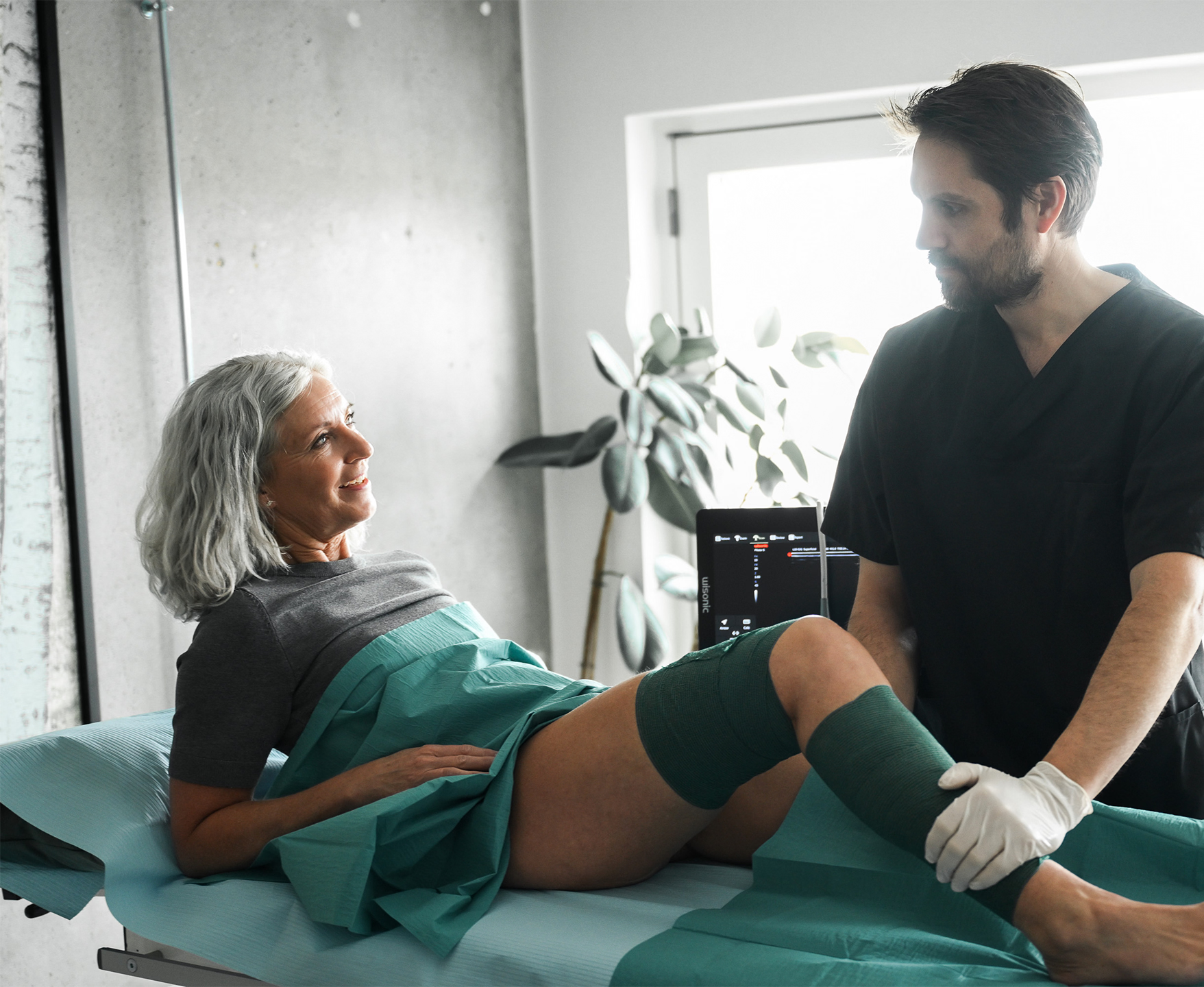
Endovenous laser ablation (EVLA) uses laser energy to seal the main trunk vein from the inside. A thin flexible fibre is guided through a small puncture in the skin into the malfunctioning vein, using ultrasound throughout. The laser is then activated as the fibre is slowly withdrawn, delivering heat that causes the vein wall to collapse and seal shut. Blood is immediately rerouted through healthy veins, and the treated vein is absorbed by the body over the following weeks and months.
EVLA is performed under local anaesthetic and takes approximately 30 to 60 minutes. No stitches are required. Patients walk out of the clinic the same day.
NICE recommendation: EVLA is listed as the first-line treatment for truncal vein incompetence in NICE guideline NG23, ahead of both foam sclerotherapy and conventional surgery.
Foam sclerotherapy works differently. A medicated foam (Sodium Tetradecyl) is injected directly into the target vein through a fine needle, guided by ultrasound. The foam displaces blood in the vein and chemically irritates the vein wall, causing it to collapse and seal. The treated vein is then gradually absorbed by the body.
Local anaesthetic is not typically required, and most patients experience only mild discomfort. The procedure is quick - usually 20 to 30 minutes - and patients can return to normal activity immediately afterwards.
NICE recommendation: Foam sclerotherapy is recommended by NICE as the first-line treatment where EVLA is not required, and as a complementary treatment alongside EVLA for residual or surface veins.
| EVLA | Foam Sclerotherapy | |
|---|---|---|
| Best for | Truncal veins (great/small saphenous vein) | Smaller/surface veins, previous treatment, residual veins |
| How it works | Laser fibre seals vein using heat | Medicated foam collapses the vein wall |
| Anaesthetic | Local anaesthetic required | Usually none needed |
| Procedure time | 30 to 60 minutes | 20 to 30 minutes |
| Recovery | Back to desk work next day | Normal activity immediately |
| NICE recommendation | First-line for truncal vein incompetence | First-line when EVLA not required |
| Often combined with | Foam sclerotherapy or phlebectomy | EVLA, as a follow-up for residual veins |
| Cost at UK Vein Care | From £1,930 (one leg) | From £680 (one leg) |
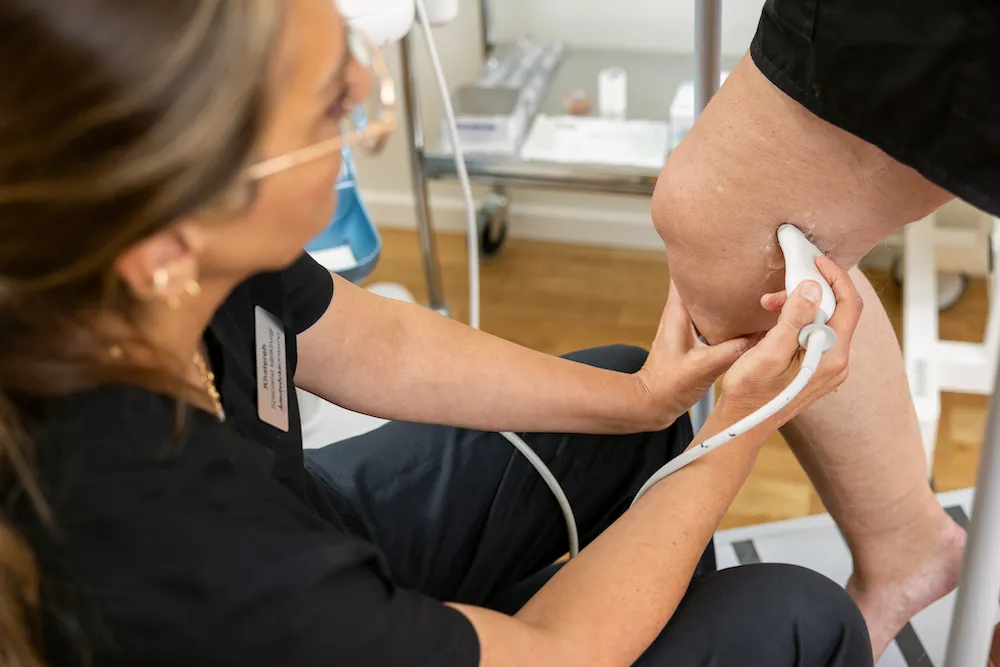
The treatment you are offered is determined by the findings of your duplex ultrasound scan, which maps the venous system in detail and identifies which veins are affected, how severely, and what the pattern of reflux looks like. Your Consultant Vascular Surgeon will also assess several factors when forming a treatment recommendation, leading to a treatment plan tailored to your individual circumstance.
EVLA is designed for truncal veins - specifically the great saphenous vein, running along the inner thigh and calf, and the small saphenous vein at the back of the lower leg. These are the veins most commonly responsible for causing varicose veins.
Foam sclerotherapy is better suited to smaller veins, more superficial branches, or veins that are anatomically irregular. It is also the preferred option for thread veins and spider veins.
If you have had varicose vein treatment previously and the main trunk veins have already been closed, any residual veins may be too small or anatomically complex for EVLA. In this scenario, foam sclerotherapy is typically the most appropriate option.
In many cases, your surgeon will recommend both treatments in a single session. EVLA closes the trunk vein, and foam sclerotherapy is then used to treat any visible surface veins at the same time. This combined approach maximises the result and avoids the need for a second procedure in most patients.
"When a patient has significant truncal reflux alongside visible surface varicose veins, treating only the truncal vein with EVLA often gives a very satisfying result on its own - the surface veins tend to collapse once the underlying pressure is removed. But in other cases, treating the surface veins with foam in the same session gives a better outcome. It is a clinical judgement based on what the ultrasound shows and the size and nature of any surface veins."
— Mr Gary Maytham, Consultant Vascular Surgeon and CMO, UK Vein Care
The difference in cost between EVLA and foam sclerotherapy reflects the difference in complexity. EVLA requires local anaesthetic, a sterile laser fibre, and precise ultrasound guidance throughout the procedure. Foam sclerotherapy is a simpler injection-based procedure.
At UK Vein Care, all pricing is fixed and transparent with no hidden fees. The full cost is confirmed before you decide to proceed.
| Treatment | One Leg | Both Legs |
|---|---|---|
| Initial Consultation (incl. ultrasound scan) | £250 | £250 |
| Endovenous Laser Ablation (EVLA) | £1,930 | On request |
| Foam Sclerotherapy | £680 | £780 |
Where both treatments are recommended in a single session, your surgeon will agree the full cost with you clearly in advance. UK Vein Care also operates a price match guarantee - if you find a specialist offering the same treatment at a lower price, we will match it.
Many patients are also covered by private health insurance. UK Vein Care is recognised by BUPA, WPA, Vitality, National Friendly, Healix, and Saga.
Both EVLA and foam sclerotherapy have strong long-term success rates when performed by an experienced vascular surgeon. For truncal vein treatment specifically, EVLA has a published closure rate of over 95% at five years. Foam sclerotherapy has a somewhat lower closure rate for truncal veins, which is why NICE recommends EVLA as the first-line option for those veins.
For smaller surface veins and residual varicose veins after primary treatment, foam sclerotherapy delivers excellent results and is the clinically appropriate tool for the job.
It is worth noting that neither treatment prevents new varicose veins from forming in future. Venous insufficiency is a progressive condition, and healthy veins can develop valve failure over time, particularly if you have a genetic predisposition. Treating your current varicose veins resolves today's problem, but a follow-up check in future years is a sensible precaution.
"Patients sometimes ask me whether one treatment is safer than the other. Both are very safe in experienced hands. The complication rate for EVLA is low, and serious adverse events are rare. Foam sclerotherapy is procedurally even simpler and also low risk. The important factors in any outcome are not only the technology itself, but the expertise of the surgeon performing the procedure, and correct treatment decisions being made based on ultrasound diagnosis."
— Mr Gary Maytham, Consultant Vascular Surgeon and CMO, UK Vein Care
For many patients reading this, the comparison between EVLA and foam sclerotherapy is somewhat academic, because the duplex ultrasound scan will determine what is appropriate. Your surgeon will not offer you a choice between the two as if selecting from a menu - they will recommend the treatment that is clinically appropriate for your veins.
What you can be confident of is that both treatments are used at UK Vein Care daily, both are performed by Consultant Vascular Surgeons, and the recommendation you receive will be based on your individual anatomy and ultrasound findings - not on cost, convenience, or commercial preference.
If you want to understand which treatment is likely to be appropriate for your veins, the right starting point is a consultation. The ultrasound scan will give you a clear picture, and your surgeon will explain the findings and recommendation in full before you decide anything.
This article is based on research and publications from reputable sources to provide you with the most reliable information. Here are some of the main sources used:
NICE Guideline: Diagnosis and Management of Varicose Veins in the Legs
https://www.nice.org.uk/guidance/cg168By using these sources, you can be sure that the article is based on current and scientifically reviewed information.

Become varicose vein free: We offer full treatment at a fixed and transparent price regardless of the treatment method. With us, there are no hidden fees.
Learn more about our prices


Take our quick self-test to find out if you qualify for varicose vein treatment.



.webp)