Specialised in varicose veins
More than 55,000 treated patients
16 UK clinics · 60 clinics across 5 countries


Medically reviewed by:
Written by:
Last updated on:
August 14, 2026
.webp)
If you have been told you have varicose veins - or you can see them on your legs yourself - you are probably wondering what can actually be done about them. The good news is that modern varicose vein treatment has changed dramatically in the last two decades. What once required a hospital stay and general anaesthetic can now be done in under an hour, in a clinic, with no time off work.
This guide explains every treatment option available in the UK today: what each procedure involves, which type of varicose veins it suits best, what to expect on the day, and what it costs at a private clinic. By the end, you will have a clear picture of which treatment is most likely to be right for you.
"The presentation and cause of varicose veins varies between patients. Successful treatment depends on the anatomy of the veins, the severity of the reflux, and the clinical history. That is why every patient at UK Vein Care undergoes a thorough duplex ultrasound scan - so we can tailor treatment to each patient's specific circumstances"
— Mr Gary Maytham, Consultant Vascular Surgeon and Chief Medical Officer, UK Vein Care
Varicose veins are caused by malfunctioning valves inside the veins. When these valves fail, blood refluxes back down the vein instead of flowing upwards to the heart. This leads to increased pressure, causing the veins to enlarge, with the characteristic twisted, bulging veins appearing on the surface of the leg.
Because the underlying problem is structural - valves that no longer close properly - varicose veins cannot resolve without treatment. Compression stockings can manage symptoms and slow progression, but they do not repair the faulty vein or remove the varicose veins. This can only be achieved by undergoing a procedure.
Leaving varicose veins untreated does carry risks. Over time, chronic venous pressure can lead to skin changes, varicose eczema, superficial blood clots (phlebitis) and in more serious cases, leg ulcers.
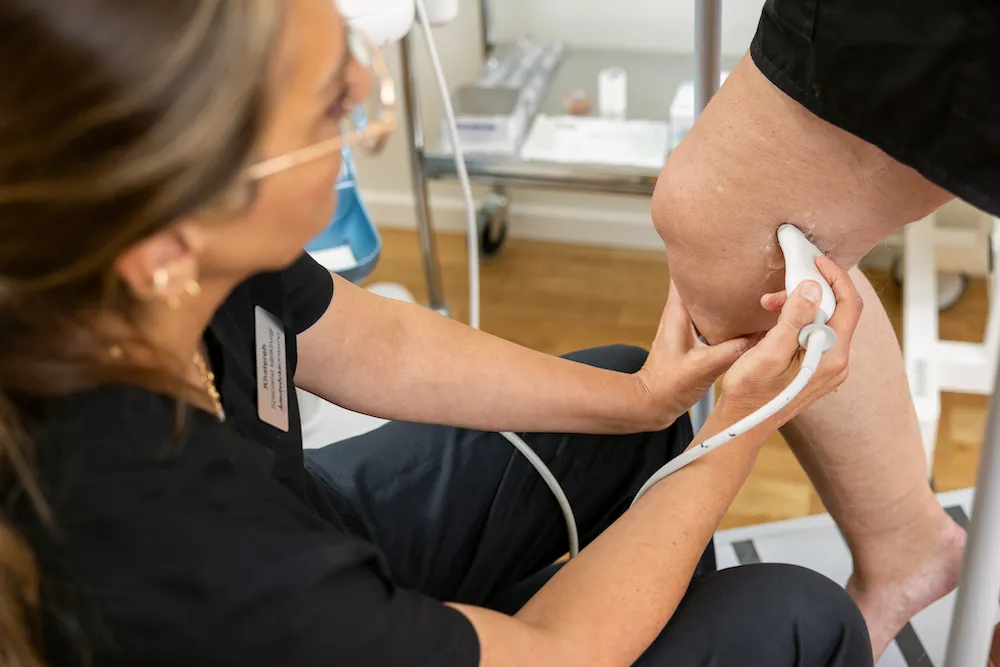
Before any treatment is recommended, a specialist will perform a duplex ultrasound scan of your legs. This painless scan maps the venous system and identifies exactly which veins are affected by reflux - the backward flow of blood that causes varicose veins.
This step is essential. It determines which treatment method is appropriate and ensures that only the diseased veins are targeted. At UK Vein Care, the ultrasound scan is carried out as part of the initial consultation and is included in the consultation fee.
Without an ultrasound, it is not possible to diagnose varicose veins accurately or plan treatment safely - regardless of how prominent the veins appear on the surface.
There are three main treatment methods used at specialist vein clinics in the UK today. Most patients are treated with one of these, or a combination of two. Which is recommended for you will depend on the size and location of the affected veins, and the findings of your ultrasound scan.
Endovenous laser ablation, or EVLA, is the treatment recommended by NICE (the National Institute for Health and Care Excellence) as the first-line treatment for the main trunk veins of the leg - specifically the great saphenous vein and small saphenous vein.
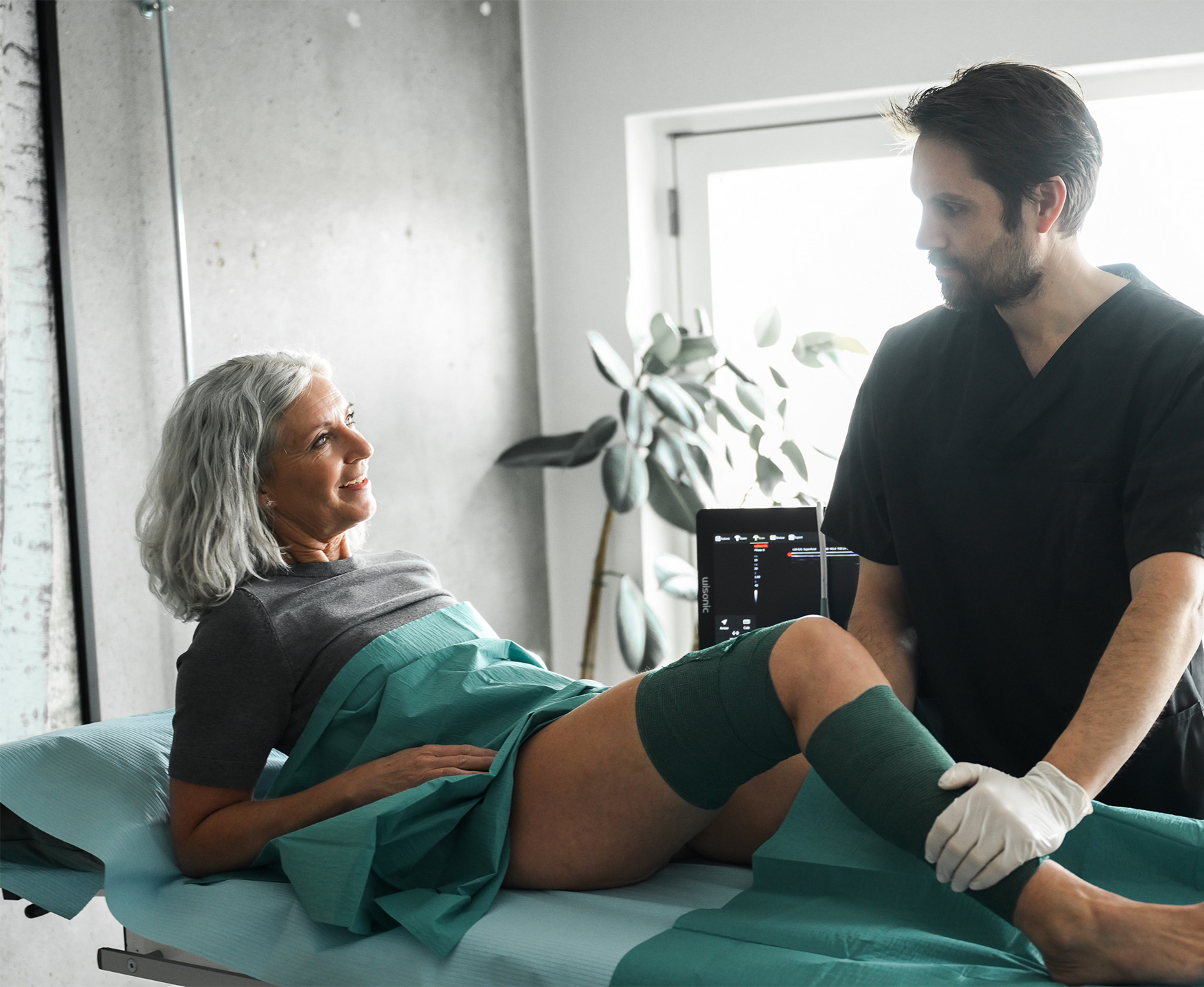
How it works: A thin, flexible fibre is inserted into the faulty vein through a small puncture in the skin - no incision or stitching required. The fibre delivers laser energy along the length of the vein, causing it to seal shut. Blood naturally reroutes through healthy veins nearby. The sealed vein is gradually absorbed by the body over the following months.
What to expect: The procedure is performed under local anaesthetic in a clinical setting, with no hospital admission. It takes approximately 30 to 60 minutes. Patients walk out of the clinic the same day and can return to desk-based work the following day.
Best for: Patients with reflux in the main trunk veins, which is the underlying cause of most visible varicose veins. EVLA treats the root cause, not just the surface appearance.
"EVLA has a very high success rate when performed by an experienced vascular surgeon using ultrasound guidance throughout. At UK Vein Care, we use EVLA as our primary treatment for truncal vein incompetence, and the results are consistently excellent. The key is precision - both in the diagnosis and in the delivery of the laser energy."
— Mr Gary Maytham, Consultant Vascular Surgeon and CMO, UK Vein Care
Foam sclerotherapy involves injecting a medicated foam (Sodium Tetradecyl) directly into the affected vein using a fine needle. The foam displaces blood in the vein and damages the vein wall, causing it to collapse and seal. Over time, the treated vein is absorbed by the body.
How it works: The procedure is guided by ultrasound to ensure precise placement of the foam into the target vein. Local anaesthetic is not required, as most patients experience little more than mild discomfort.
What to expect: Foam sclerotherapy is quick and gentle. Patients can resume normal daily activities immediately after treatment. There is no downtime or recovery period.
Best for: Smaller and more superficial varicose veins, and patients who have previously been treated for varicose veins where the main trunk veins have already been closed. Foam sclerotherapy is also used alongside EVLA to treat residual surface veins after the primary procedure.
A phlebectomy (also called avulsion) is used to remove the physically visible, bulging section of a varicose vein through tiny micro-incisions in the skin. The incisions are so small that no stitches are required, and any marks fade over time.
How it works: Under local anaesthetic, the surgeon makes a series of tiny punctures along the course of the visible vein. A small hook instrument is used to draw out the vein segment through each puncture. The procedure takes place in a clinic setting.
Best for: Patients with prominent surface varicose veins who want to remove the cosmetic appearance of the veins. Phlebectomy is most commonly performed in combination with EVLA or foam sclerotherapy - EVLA treats the underlying cause while phlebectomy removes the visible result.
One of the most common questions patients ask is how much varicose vein treatment costs. The honest answer is that it depends on which veins need treating, which procedure is most appropriate, and whether one or both legs require treatment.
At UK Vein Care, pricing is fixed and transparent - there are no hidden fees or vague 'from' prices. Every patient receives a clear price following their ultrasound consultation, before committing to any treatment.
| Treatment | One Leg | Both Legs |
|---|---|---|
| Initial Consultation (incl. ultrasound) | £250 | £250 |
| Foam Sclerotherapy | £680 | £780 |
| Endovenous Laser Ablation (EVLA) | £2,495 | On request |
| Microsclerotherapy (spider/thread veins) | Per session | |
For context, the UK market range for EVLA is broadly £1,795–£2,749 for one leg at established specialist clinics. UK Vein Care's pricing sits at the accessible end of this range while all treatments are performed by Consultant Vascular Surgeons - not nurses or general practitioners.
Price guarantee: UK Vein Care offers a price match guarantee. If you find a specialist offering the same treatment at a lower price, we will match it.
NHS treatment for varicose veins is available, but access is increasingly restricted. Most NHS trusts will only fund treatment where varicose veins have caused a clinical complication - such as a leg ulcer, skin changes (CEAP classification C4 or above), or significant bleeding. Cosmetic or discomfort-related varicose veins are rarely funded.
Private treatment removes the waiting list and allows you to be treated at a time that suits you, with a Consultant Vascular Surgeon of your choosing, at a clinic near you.
Many patients are also covered by private health insurance. UK Vein Care is recognised by major insurers including BUPA, WPA, Vitality, National Friendly, Healix, and Saga.
One of the biggest advantages of modern varicose vein treatment is the speed of recovery. Unlike traditional surgery, minimally invasive procedures require no hospital stay and minimal downtime.
Some bruising, swelling, or mild discomfort is normal in the days following treatment and resolves quickly. Significant complications are rare when treatment is performed by an experienced vascular surgeon under ultrasound guidance.
Not all varicose vein providers are equal. Before choosing a clinic, there are several important questions to ask:
At UK Vein Care, all treatments are performed by GMC-registered Consultant Vascular Surgeons. Your initial consultation will be with the surgeon who will be undertaking the procedure, so you will be fully aware of who will be treating you, and the surgeon will be involved in the whole of your UK Vein Care pathway. Duplex ultrasound is used throughout - for diagnosis, during treatment, and at follow-up. Pricing is transparent and fixed, and the clinic network operates under the governance of Mr Gary Maytham, who serves as Chief Medical Officer.
"Patients should feel confident asking their provider who will actually perform their procedure, and what qualifications they hold. In a specialist vein clinic, your treatment should be carried out by a Consultant Vascular Surgeon - not someone working under their supervision. That standard of care makes a real difference to outcomes."
— Mr Gary Maytham, Consultant Vascular Surgeon and CMO, UK Vein Care
If you have varicose veins and are considering treatment, the right starting point is a consultation with a vascular specialist. At UK Vein Care, the consultation includes a full duplex ultrasound scan, a clinical assessment by a Consultant Vascular Surgeon, and a clear treatment recommendation with transparent pricing.
There is no referral needed from your GP. You can book directly online or by calling 0330 808 8704. UK Vein Care has clinics across England and Scotland, with short waiting times.
This article is based on research and publications from reputable sources to provide you with the most reliable information. Here are some of the main sources used:
NICE Clinical Guideline CG168: Varicose Veins Diagnosis and Management
https://www.nice.org.uk/guidance/cg168By using these sources, you can be sure that the article is based on current and scientifically reviewed information.

Become varicose vein free: We offer full treatment at a fixed and transparent price regardless of the treatment method. With us, there are no hidden fees.
Learn more about our prices


Take our quick self-test to find out if you qualify for varicose vein treatment.